

How CPOs Build Scalable EV Charging Networks
How CPOs Build Scalable EV Charging Networks

Scaling an EV charging network is not only about installing more chargers. It is about building the operational systems that help every new site run reliably, commercially and with less manual effort.
By Nexinev • 5-minute read
A clear pattern is emerging across the EV charging industry. Some Charge Point Operators expand smoothly into new locations and customer segments. Others reach a point where every new charger adds more support work, more manual tracking and more operational pressure.
The difference is rarely the charger alone. Growing CPOs design their operations for future scale from the beginning. They treat launch as the starting line and build the visibility, control and commercial flexibility needed to support a much larger network.
Scaling Starts With the Operational Foundation
A well-operated charging network can become a dependable revenue engine, a trusted partner for enterprise clients and a scalable business that grows without breaking its internal processes. Getting there requires more than hardware. It requires a system that gives teams visibility, control and commercial flexibility at every stage.
1. Centralized Network Visibility Supports Better Decisions
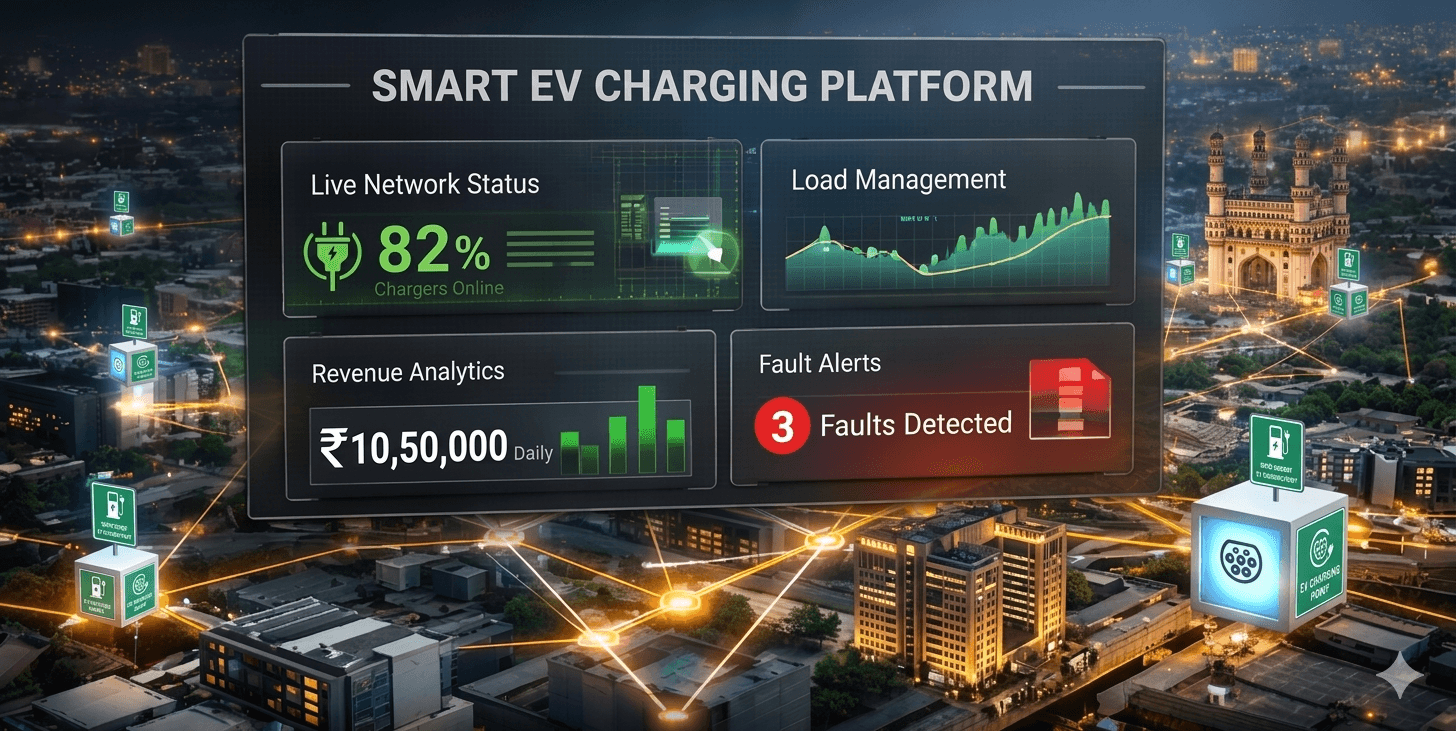
Operations teams need one clear view of charger status, connector availability, active sessions, fault activity, revenue flow and site performance. Without that, teams spend valuable time moving between portals, spreadsheets and support messages.
NexinEv helps bring network operations into a central view so teams can compare locations, identify underperforming sites and understand whether an issue is limited to one connector or affecting a wider site. This is the base for moving from reactive support to proactive network management.
2. Remote Diagnostics Improve Operational Response
As a charging network expands, sending a technician for every issue becomes slow and inefficient. Remote diagnostics help teams investigate faults, review charger information and take appropriate remote actions before deciding whether a site visit is required.
This does not remove the need for field maintenance. It helps teams use field support more carefully. When a technician is needed, better diagnostic context can make the visit more focused and better prepared.
3. Flexible Tariffs and Access Rules Support Different Business Models
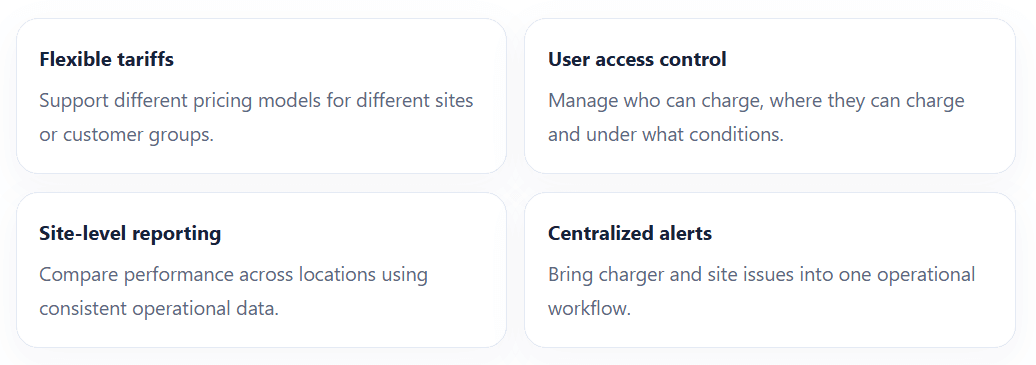
A scalable network must support different customers without creating a separate manual process for each one. Public charging, fleet charging, residential communities and enterprise sites may all need different pricing, access rules, billing structures and reports.
4. Intelligent Load Management Protects Site Capacity
Fleet depots and commercial charging hubs often need several vehicles to charge at the same time. Intelligent load management helps distribute available power across active sessions so the site can operate within its electrical limits.
This becomes valuable when a CPO expands an existing location. Instead of treating every increase in demand as a hardware problem, the operator can first understand how available power is being used across bays and sessions.
5. Network Analytics Supports Smarter Expansion
Growth decisions should be based on real network performance. Utilization, energy delivered, successful sessions, recurring faults and revenue trends help operators understand which sites are ready for expansion and which need operational improvement first.
Scalability is not simply the ability to add more chargers. It is the ability to add them without repeating the same operational problem at a larger scale.
NexinEv brings these operational areas into one connected platform: network visibility, remote actions, alerts, tariffs, load management and analytics. The goal is not to make growth look simple. It is to make growth more manageable.
Scaling an EV charging network is not only about installing more chargers. It is about building the operational systems that help every new site run reliably, commercially and with less manual effort.
By Nexinev • 5-minute read
A clear pattern is emerging across the EV charging industry. Some Charge Point Operators expand smoothly into new locations and customer segments. Others reach a point where every new charger adds more support work, more manual tracking and more operational pressure.
The difference is rarely the charger alone. Growing CPOs design their operations for future scale from the beginning. They treat launch as the starting line and build the visibility, control and commercial flexibility needed to support a much larger network.
Scaling Starts With the Operational Foundation
A well-operated charging network can become a dependable revenue engine, a trusted partner for enterprise clients and a scalable business that grows without breaking its internal processes. Getting there requires more than hardware. It requires a system that gives teams visibility, control and commercial flexibility at every stage.
1. Centralized Network Visibility Supports Better Decisions
Operations teams need one clear view of charger status, connector availability, active sessions, fault activity, revenue flow and site performance. Without that, teams spend valuable time moving between portals, spreadsheets and support messages.
NexinEv helps bring network operations into a central view so teams can compare locations, identify underperforming sites and understand whether an issue is limited to one connector or affecting a wider site. This is the base for moving from reactive support to proactive network management.
2. Remote Diagnostics Improve Operational Response
As a charging network expands, sending a technician for every issue becomes slow and inefficient. Remote diagnostics help teams investigate faults, review charger information and take appropriate remote actions before deciding whether a site visit is required.
This does not remove the need for field maintenance. It helps teams use field support more carefully. When a technician is needed, better diagnostic context can make the visit more focused and better prepared.
3. Flexible Tariffs and Access Rules Support Different Business Models
A scalable network must support different customers without creating a separate manual process for each one. Public charging, fleet charging, residential communities and enterprise sites may all need different pricing, access rules, billing structures and reports.
4. Intelligent Load Management Protects Site Capacity
Fleet depots and commercial charging hubs often need several vehicles to charge at the same time. Intelligent load management helps distribute available power across active sessions so the site can operate within its electrical limits.
This becomes valuable when a CPO expands an existing location. Instead of treating every increase in demand as a hardware problem, the operator can first understand how available power is being used across bays and sessions.
5. Network Analytics Supports Smarter Expansion
Growth decisions should be based on real network performance. Utilization, energy delivered, successful sessions, recurring faults and revenue trends help operators understand which sites are ready for expansion and which need operational improvement first.
Scalability is not simply the ability to add more chargers. It is the ability to add them without repeating the same operational problem at a larger scale.
NexinEv brings these operational areas into one connected platform: network visibility, remote actions, alerts, tariffs, load management and analytics. The goal is not to make growth look simple. It is to make growth more manageable.




The Future of EV Charging
Why CPOs Need a Smarter Software Platform in 2026

How to Improve EV Charger Uptime
A Practical Guide for CPOs

EV Charging Trends that will impact your network
Focus on scaling and growing your EV networks

How top CPOs Build scalable Networks
The Operational Foundation
The Future of EV Charging
Why CPOs Need a Smarter Software Platform in 2026
How to Improve EV Charger Uptime
A Practical Guide for CPOs
EV Charging Trends that will impact your network
Focus on scaling and growing your EV networks
How top CPOs Build scalable Networks
The Operational Foundation

Ready to Run EV Charging Operations at Scale?
Join us like our customers who trust NEXINEV to power their charging infrastructure.
How CPOs Build Scalable EV Charging Networks
Scaling an EV charging network is not only about installing more chargers. It is about building the operational systems that help every new site run reliably, commercially and with less manual effort.
By Nexinev • 5-minute read
A clear pattern is emerging across the EV charging industry. Some Charge Point Operators expand smoothly into new locations and customer segments. Others reach a point where every new charger adds more support work, more manual tracking and more operational pressure.
The difference is rarely the charger alone. Growing CPOs design their operations for future scale from the beginning. They treat launch as the starting line and build the visibility, control and commercial flexibility needed to support a much larger network.
Scaling Starts With the Operational Foundation
A well-operated charging network can become a dependable revenue engine, a trusted partner for enterprise clients and a scalable business that grows without breaking its internal processes. Getting there requires more than hardware. It requires a system that gives teams visibility, control and commercial flexibility at every stage.
The Hidden Complexity behind every charging network
As a network grows, operators must also manage tariffs, user access, remote commands, fault alerts, load limits, refunds, reporting and third-party integrations. When this information is spread across different portals or spreadsheets, teams spend more time finding the issue than solving it.
Real-time visibility helps teams identify and respond to charger issues faster.
Traditional monitoring is no longer enough because a charger can appear online and still fail to start sessions consistently. A modern EV charging platform should provide visibility at charger, connector, session and site level. It should show what happened, how users may be affected and what the operations team should do next.
Useful software should move operators from “something is wrong” to “here is the issue, its impact and the next action.”
Why Traditional Monitoring Isn’t Enough Anymore
Why Traditional Monitoring Isn’t Enough Anymore
Many operators still rely on:
Manual monitoring
Disconnected systems
Limited real-time visibility
This leads to:
Slow fault detection
High maintenance costs
Low charger utilization
Reduced driver trust
Modern EV networks demand real-time control, automation, and scalability.
1. Centralized Network Visibility Supports Better Decisions
Operations teams need one clear view of charger status, connector availability, active sessions, fault activity, revenue flow and site performance. Without that, teams spend valuable time moving between portals, spreadsheets and support messages.
NexinEv helps bring network operations into a central view so teams can compare locations, identify underperforming sites and understand whether an issue is limited to one connector or affecting a wider site. This is the base for moving from reactive support to proactive network management.
2. Remote Diagnostics Improve Operational Response
As a charging network expands, sending a technician for every issue becomes slow and inefficient. Remote diagnostics help teams investigate faults, review charger information and take appropriate remote actions before deciding whether a site visit is required.
This does not remove the need for field maintenance. It helps teams use field support more carefully. When a technician is needed, better diagnostic context can make the visit more focused and better prepared.
Many operators still rely on:
Manual monitoring
Disconnected systems
Limited real-time visibility
This leads to:
Slow fault detection
High maintenance costs
Low charger utilization
Reduced driver trust
Modern EV networks demand real-time control, automation, and scalability.
What a Future-Ready EV Platform Should Offer

A next-generation platform must go beyond basic monitoring. It should deliver:
· Real-Time Network Visibility
· Intelligent Load Management
· Modular & Scalable Architecture
· Interoperability
· Advanced Analytics

The shift & support from Hardware-Centric to Software-Led Operations
Hardware installs networks.
Software scales them. It becomes the operational backbone of the charging ecosystem.
As EV adoption grows, CPOs who invest in intelligent software platforms gain:
Higher uptime
Predictable revenue streams
Lower operational costs
Better driver retention
Stronger enterprise partnerships


The Competitive Edge Is Operational Intelligence
3. Flexible Tariffs and Access Rules Support Different Business Models
A scalable network must support different customers without creating a separate manual process for each one. Public charging, fleet charging, residential communities and enterprise sites may all need different pricing, access rules, billing structures and reports.
4. Intelligent Load Management Protects Site Capacity
Fleet depots and commercial charging hubs often need several vehicles to charge at the same time. Intelligent load management helps distribute available power across active sessions so the site can operate within its electrical limits.
This becomes valuable when a CPO expands an existing location. Instead of treating every increase in demand as a hardware problem, the operator can first understand how available power is being used across bays and sessions.
5. Network Analytics Supports Smarter Expansion
Growth decisions should be based on real network performance. Utilization, energy delivered, successful sessions, recurring faults and revenue trends help operators understand which sites are ready for expansion and which need operational improvement first.
Scalability is not simply the ability to add more chargers. It is the ability to add them without repeating the same operational problem at a larger scale.
NexinEv brings these operational areas into one connected platform: network visibility, remote actions, alerts, tariffs, load management and analytics. The goal is not to make growth look simple. It is to make growth more manageable.
More Articles
The Future of EV charging
Why CPOs Need a Smarter Software Platform in 2026
How top CPOs Build scalable Networks
The Operational Foundation
How to Improve EV Charger Uptime
A Practical Guide for CPOs
EV Charging Trends that will impact your network
Focus on scaling and growing your EV networks
Ready to Run EV Charging Operations at Scale?
Join us like our customers who trust NEXINEV to power their charging infrastructure.
Ready to Run EV Charging Operations at Scale?
Join us like our customers who trust NEXINEV to power their charging infrastructure.